Showing posts with label Elementary Art Assessment. Show all posts

Saturday, April 20, 2013

West Tennessee Art Education Association Conference

I have just returned from Memphis, Tennessee where I taught my first hands on teacher workshop. What an amazing experience! The participants were at the Memphis College of Art on a Saturday to be professionally developed in all things assessment.

I planned the activities with the idea of Experience before Label in mind. (Kudos to you if you recognize that Quantum Learning Key!) Anyway, I have sat through my share of "lectures" so I thought my fellow elementary folks would enjoy a little music, a little hands on and a whole lot of assessment!

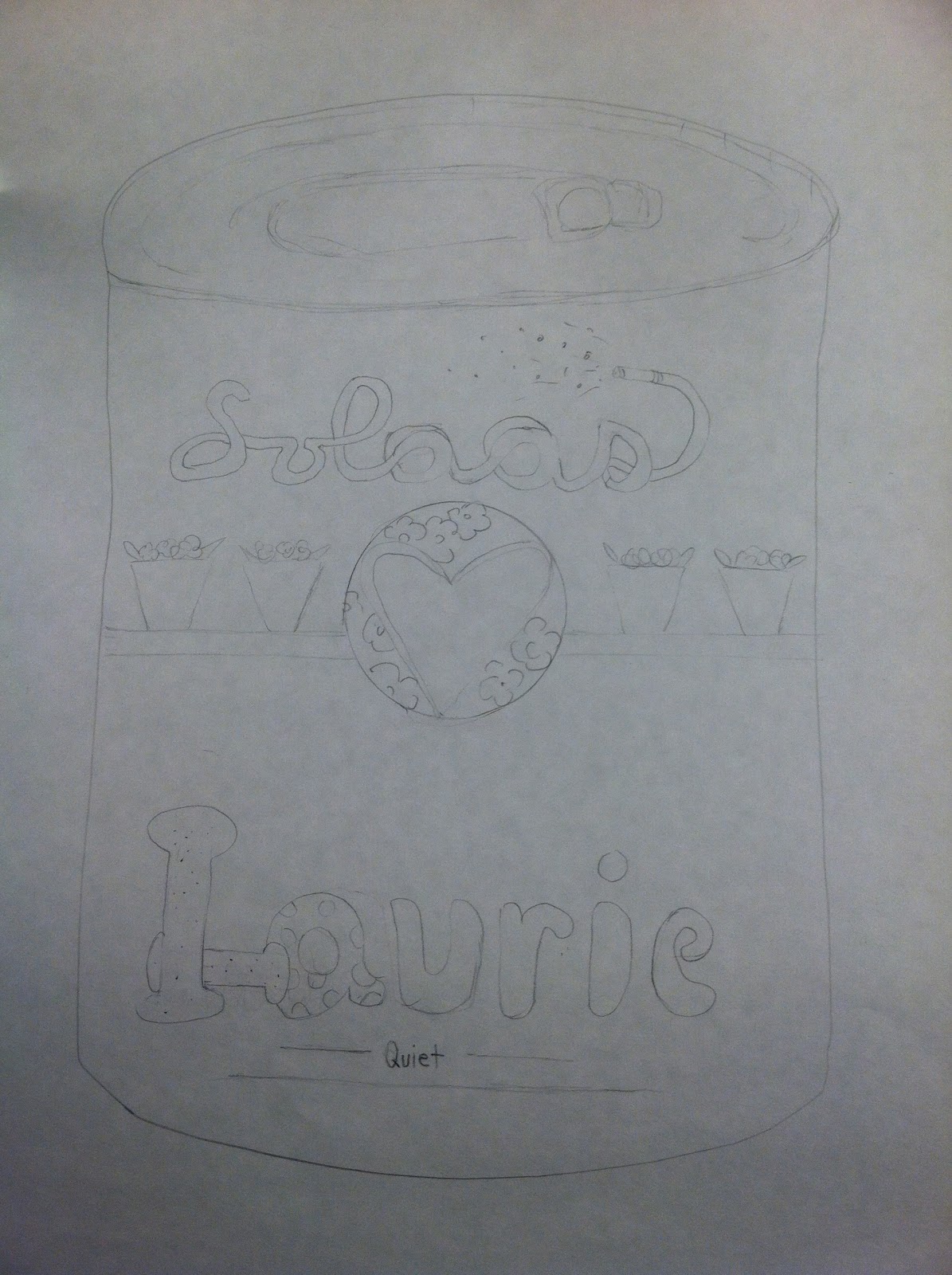
I modeled an Identity unit I developed several years ago in response to a Pop Art exhibit at our local museum. Designed for 4th graders, students explore the concept of Identity by looking at everyday objects and symbols. This lesson stretches the student's idea of what a self-portrait is beyond just the physical characteristics of the artists. By looking closely at non-traditional self-portraits as well as the work of Andy Warhol's use of repetition and variation. Embedded in this unit participants used idea books, essential questions, check lists, rubrics, and student self reflections. The feedback was very positive so I have decided to submit this model to NAEA 2014! Here are some of the work-in-progress that teachers created today! Imagine 100 Soup Can Self-portraits hanging together! The portraits, like people, look the same from a distance, but up close you realize that each one is an individual! Our students are not just numbers, a brick in the wall, they are people, each unique individuals.
3-D Soup Can- OH-YEAH!


So, what did I learn? 
  • I learned that I love teaching art teachers!
  • Well crafted units get the same response not matter what group you teach it to and that was just plain fun to be a part of!!
  • I have something valuable to share and so do you. 
  • We all find our voices in different ways at different times  and maybe I have found mine. 
  •  Being an ostrich (head in the sand) or a gazelle (running away) about scary stuff like assessment will not help you master it. By accepting the challenge, taking risks and trying something new, even failing, you show yourself and your students that you are a life-long-learner and you are not afraid to learn from your mistakes. What a great way to teach our students grit!!

Tuesday, April 2, 2013

Assessment Tools for the Elementary Visual Arts Classroom

It is now online! I couldn't email the presentation that I used at this year's NAEA conference in Fort Worth because of it's size, but I have had a lot of requests for it. It has a lot of great visual examples that will be showing up on my blog soon, but in the mean time, here it is! I posted it on my Teacherpayteacher.com page. Don't worry, it's free!
TpT is a great site for resources if you haven't checked it out yet. I have used it to get ideas. For a dollar or two you can find some amazing, teacher-made resources. (It is kind of like a consignment sale.) You know what they say, time is money! Sometimes you have time to modify but not create and there are a lot of free things. The first thing you post has to be free. And it is free to sell too...you could earn some money for extra supplies!! Just saying!

Monday, February 25, 2013

Assessment Season

Well, here in Tennessee it is Assessment Season. This is the time when March Madness refers to everyone scrambling and cramming for "the test". I am gearing up for 3rd quarter report cards and heading to NAEA next week to present some things on assessment (Assessment tools for the Elementary Art Classroom, Thursday at 2:00pm if you will be in Fort Worth) so I thought I would get warmed up here first.

One tool I like to use in my classroom is an Idea Book. This is the new cover for next year. I found it helpful to add the table designation to save time. That way when I'm passing them out I just need to look at the table instead of finding each child by name. I can also have them out on the table when they come in without have 25-30 seating charts memorized.
I teach 1st-4th using enduring themes whenever possible so I only use the idea books with these grade levels, not with Kindergarten. When I intro a unit, I usually start with questions. I type these up and print them out (usually 2 or 3 sets to a page so it is less copies). This saves time because the children are not copying from the board which uses valuable class time. This also diversifies the instruction because students can see the question in front of them, on the big screen as well as hear/read it. We do our practice sketches in this book too. They are super cheap to make. I use 5 sheets of 11x17 with one colored sheet for the cover. Fold it in half with two staples on the fold and you have a super cheap idea book, color coded by grade level with 10 pages, or 20 front and back! It's use creates a portfolio of thinking and shows how students grow both in process and over time. 

The idea book becomes the pre-test and the completed work is the post-test to show student growth.  Another way that I gauge student growth is by using student self-assessment or reflection. This comes in many forms but my favorite for its speed and simplicity is a checklist.
This is my son's paper rug. 
In this example I give students four "I" statements and they respond "yes", "sort of" or "no". This helps me to understand if the students recognize and can use the weaving vocabulary in written and verbal form. I observe the verbal in class while the rug is being created as well as listen to them while they fill out the student evaluation. This is a first grade example so I do read through the statements with them to be sure that lack of reading skills does not keep them from showing what they know. At the bottom I added a matching section for students to recall the process of weaving. This worked better than last year when I had them number the statements.

I also use fill-in-the-blank with first and second. This is another first grade example. I know it is harder to picture it with the younger ones. In this innovation unit, students designed a "robot" and stamped it with found objects. The robot had to be specifically designed for a planet or location in space. Students then created an outer-space landscape using markers and pastel and glued in the robot where it made the most sense on the picture plane. They love this one- they have a chance to tell the viewer what the robot was designed to do and what changes need to be made to the design, if any. The mission report is a quick way to allow students to reflect on what they have learned and created through art. 
I also use Artsonia.com, the online student art gallery. It is amazing to see the growth and progress over the years. Of course we have no way of storing a self-portrait each year for five years and even if we could some of our schools are so transient that you could never keep track of them all. This way, Artsonia archives all the work for you. Here are two portraits by Maggie, one in Kindergarten and one in Third grade. It is amazing to see the growth there!


Check out my school on Artsonia.com           http://www.artsonia.com/schools/school.asp?id=76429